Skip to content
Moroccan mountain road
Transportation

Getting Around Morocco: Train, Bus, Taxi or Rental Car?

Morocco has good trains, excellent long-distance buses, legendary shared taxis and roads that reward confident drivers. Here is the honest comparison — which mode for which route, what it really costs, and the mistakes first-timers keep making.

Eddyafa Travel
Journal
In this article4 min read

The quick answer

If you remember one paragraph, make it this one. Morocco's train network (ONCF) links the big cities — Casablanca, Rabat, Tangier, Fes, Meknes, Oujda and Marrakech — fast, cheap and air-conditioned. Everything the train does not reach is covered by long-distance buses. Within a city or a region, you use petits taxis or shared grands taxis. And you only need a rental car if your route runs through the Atlas, the desert or the wild Atlantic south — places where timetables stop and scenery starts.

The classic first-timer mistake is renting a car for the whole country. You will spend half the trip hunting parking outside medinas you are not allowed to drive into anyway, and pay double what buses cost. The classic second mistake is trying to do everything by train and discovering too late that Essaouira, Merzouga and the mountains have no station at all.
Private airport transfer car in Morocco

The trains: where they go and how they feel

ONCF runs a modern, double-track network along the Atlantic corridor and inland to the imperial cities. The Tanger–Casablanca Al Boraq line is genuine high speed at 320 km/h; elsewhere trains cruise at 100–160 km/h on rolling stock that would not embarrass a European operator. Journeys are calm, the café cars work, and the stations are the safest public spaces in the country.

Practical details: buy second class for anything under three hours — it is air-conditioned and usually half the price. First class earns its keep on the Casablanca–Marrakech run. Reserve in the ONCF app or at the counter; trains sell out on Fridays and during Eid. And note what is missing: no train to Essaouira, Agadir, the Sahara or the High Atlas villages. The train gets you across the country; the last hour is always something else.

Buses: the real national network

If trains are the spine, buses are the circulatory system. CTM is the reliable one — new coaches, assigned seats, luggage under the bus, air conditioning that arctic expeditioners could admire. Supratours is the ONCF's own bus arm and plugs the train gaps, which makes Marrakech–Essaouira or Fes–Merzouga one ticket. Smaller companies (FR-ATS, Riad Buses, Transit Maroc) cover the secondary roads and cost a third less.

Book a day ahead in high season for the popular runs — the 8am CTM to Essaouira sells out. Night buses on the Casablanca–Agadir or Marrakech–Tafraoute runs save a hotel night, though the mountain ones arrive at 4am, which is its own kind of expensive.

Tourist transport minibus in Morocco

Grand taxis: the system everyone misreads

A grand taxi is not a large taxi — it is a shared seven-seat Mercedes that runs fixed routes between towns, filling up and leaving. You pay per seat to your destination, not per car, and locals pay exactly what you pay. The petit taxi inside cities is the metered one: insist on the meter (compteur) or agree the price before the doors close.

The rules that matter: front seat belongs to the driver unless you are three or fewer passengers, so a solo traveller usually rides in front. Bags go on the roof or squeeze in. For a private grand taxi — the sensible move for the Dadès gorge or the road to Merzouga — negotiate the whole car in advance, in daylight, and settle the price before anyone sits down. Doubling the quoted shared rate buys you the vehicle outright; that is the entire negotiation.

Rental cars: when they are worth it

Morocco is an easy country to drive — motorway standards between cities, cheap fuel, and the driving culture is assertive rather than aggressive. What is hard is parking: medinas are pedestrian, so your car sits in a guarded lot on the edge while you walk in, and in Marrakech or Fes that lot is a fifteen-minute walk from your riad.

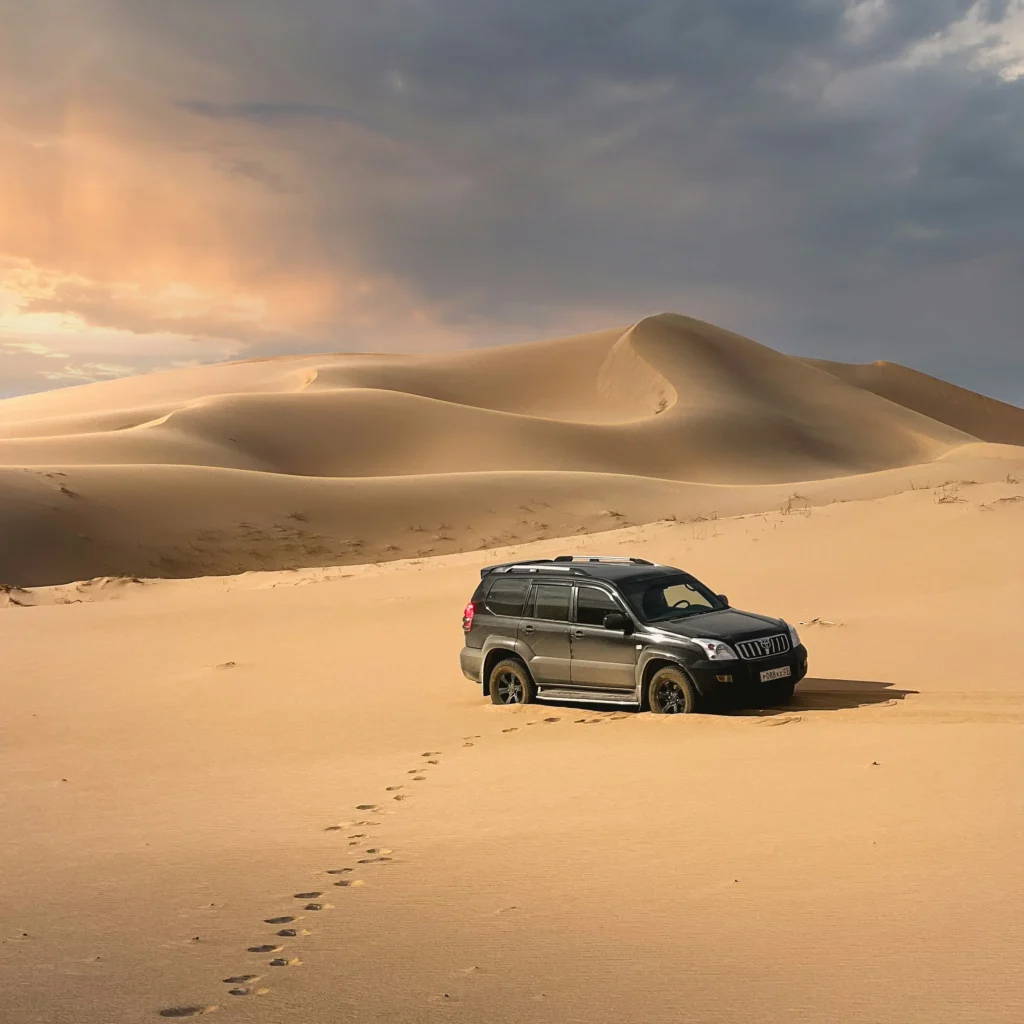
Rent only when the itinerary demands it: a loop through the High Atlas, the Dadès–Todra–Merzouga run, or the Atlantic coast south of Essaouira. Bring an International Driving Permit alongside your licence, photograph the car on pickup and return, decline the famously pushy insurance upsell at the desk, and check the fuel policy. One more thing: mountain roads are beautiful and unforgiving at night — drive the Tichka and the Atlas passes in daylight or not at all.

Self-drive rental car on a Moroccan road

Putting it together

Two sample weeks, done without a rental car. First: train to Marrakech, CTM bus to Essaouira, grand taxi to the Imlil valley in the Atlas, train home — three modes, zero parking stress. Second: train to Fes, Supratours overnight to Merzouga, shared grand taxi back through the valleys — you cross the whole country and never touch a steering wheel.

And the hybrid most people end up with: trains and buses for the spine of the trip, then a private car with a driver for the two or three days in the mountains or the desert, negotiated locally or through your riad. A driver-guide for those days costs less than a rental plus fuel plus the parking plus the grey hair, and he knows which side of the road the goats are on.

Begin your adventure

Your dream Morocco trip starts here

Tell us where you want to go, when, and at what pace — we’ll craft a tailor-made itinerary with private transport, hand-picked riads and local guides.