Skip to content
Lively street in a Moroccan medina
Money

Money in Morocco: Cash, Cards, Tipping and Fair Prices

The dirham is a closed currency, cards run most of the cities and the souks still run on cash and conversation. Here is how to actually pay for things in Morocco — what things cost to move, who gets tipped and how much, and how to bargain without becoming the story someone tells at dinner.

Eddyafa Travel
Journal
In this article6 min read

Cash is king — but not everywhere

Morocco runs on the dirham, and for daily life cash still rules: souks, taxis, market stalls, corner cafés and most riads prefer notes. Cards work in the other half of the country — hotels, larger restaurants, petrol stations and shops with a card machine — but assuming card everywhere is the fastest way to stand embarrassed at a small restaurant table.

The practical shape of a day is this: draw cash once every few days from a bank ATM, keep smaller notes for taxis and tips, and let the card handle the big fixed costs — hotels, rental cars, guided tours. Everything below is detail around that simple skeleton.
  1. The dirham: what to know before you land

    The Moroccan dirham is written MAD or DH, and it is a closed currency: you cannot reliably buy it before you arrive, so there is no point hunting for a bureau in your home airport. You get dirhams in Morocco — from ATMs, from exchange offices, or as change from a card payment.

    Notes come in 20, 50, 100 and 200 dirhams; coins in 1, 2, 5 and 10 dirhams, with small centime coins that mostly disappear into pockets. The practical consequence: 200-dirham notes are hard to break for a 15-dirham taxi, so withdraw a mix and always keep some 20s and 50s on you.

  2. ATMs: the cheapest route to cash

    Bank ATMs are the standard way travellers get dirhams, and they are dense in every city and town — look for machines attached to real bank branches rather than lone boxes in tourist squares. Visa and Mastercard both work; the machine asks whether to charge you in dirhams or your home currency, and the answer is always dirhams.

    Choosing your own bank's currency lets the machine's network set an exchange rate you did not agree to — that is the hidden fee, and it can quietly add several percent. Beyond that, the usual discipline applies: tell your bank you are travelling, withdraw larger amounts less often to pay one flat fee instead of five, and do the maths once so the daily limit does not surprise you mid-trip.

  3. Where cards work — and where they really don't

    In cities, card acceptance is broad and contactless is common: hotels and riads, sit-down restaurants, supermarkets, petrol stations, electronics shops and most tourist agencies take Visa and Mastercard without comment. American Express is much patchier — treat it as a backup, not a plan.

    Where cards disappear entirely: souk stalls, petit taxis, minibuses, street food, beach shacks, hammams, rural guesthouses and the small cafés where half the memorable meals happen. Carry enough cash to end any day happily, because the moment you need it is never the moment you planned to find an ATM.

  4. Changing money: bureaux, hotels and what to avoid

    If you prefer cash over ATMs, exchange offices in city centres give noticeably better rates than hotel desks or airport counters, and the difference over a whole trip is a nice dinner. Rates are posted on the door; compare two or three on the same street before handing anything over.

    Bring clean money. Bureaux refuse torn, marked or heavily worn notes — a folded corner on a euro bill can turn into a ten percent loss — and larger denominations change at better rates than a stack of small ones. Avoid anyone offering to change money on the street: the rate that sounds wonderful is where the counterfeit note enters your wallet.

  5. Tipping: the numbers people actually use

    Tipping in Morocco is expected but relaxed, and nobody presents a percentage card. These are the amounts locals and regular visitors actually leave — carry small notes for all of them, because breaking a 100 at a café for a coffee is how tensions start.

    • Restaurants: round up, or 5 to 10 percent when the service was genuinely good; leave it on the table or hand it to the server.
    • Cafés and street stalls: keep the change — a dirham or two is the whole tip.
    • Taxis: round the fare up; exact change is accepted, small kindness is remembered.
    • Guides and drivers on day trips: around 100 to 200 dirhams per person per day for a guide, less for a driver you share with others.
    • Riads and hotels: a few dirhams for the porter, and something for the housekeeping and kitchen staff if you stayed more than a night.
    • Hammams and public baths: the attendant who scrubs and brings towels gets a small tip at the end.
  6. Haggling without humiliation

    In the souks, the first price is an opening position, and both sides know it. Start at roughly a third to a half of the ask, negotiate upwards with a smile, and be ready to actually buy at a price you both accept — the deal is only real when money changes hands, and pretending otherwise wastes everyone's afternoon.

    There is also a line where bargaining stops being fun: fixed-price shops, supermarkets, pharmacies and anything with a printed price tag. And if you have bought something from a stallholder earlier in the day, they will often shave the last few dirhams off the next purchase — small commerce runs on relationships, and the tourist who returns is worth more than the one who vanishes.

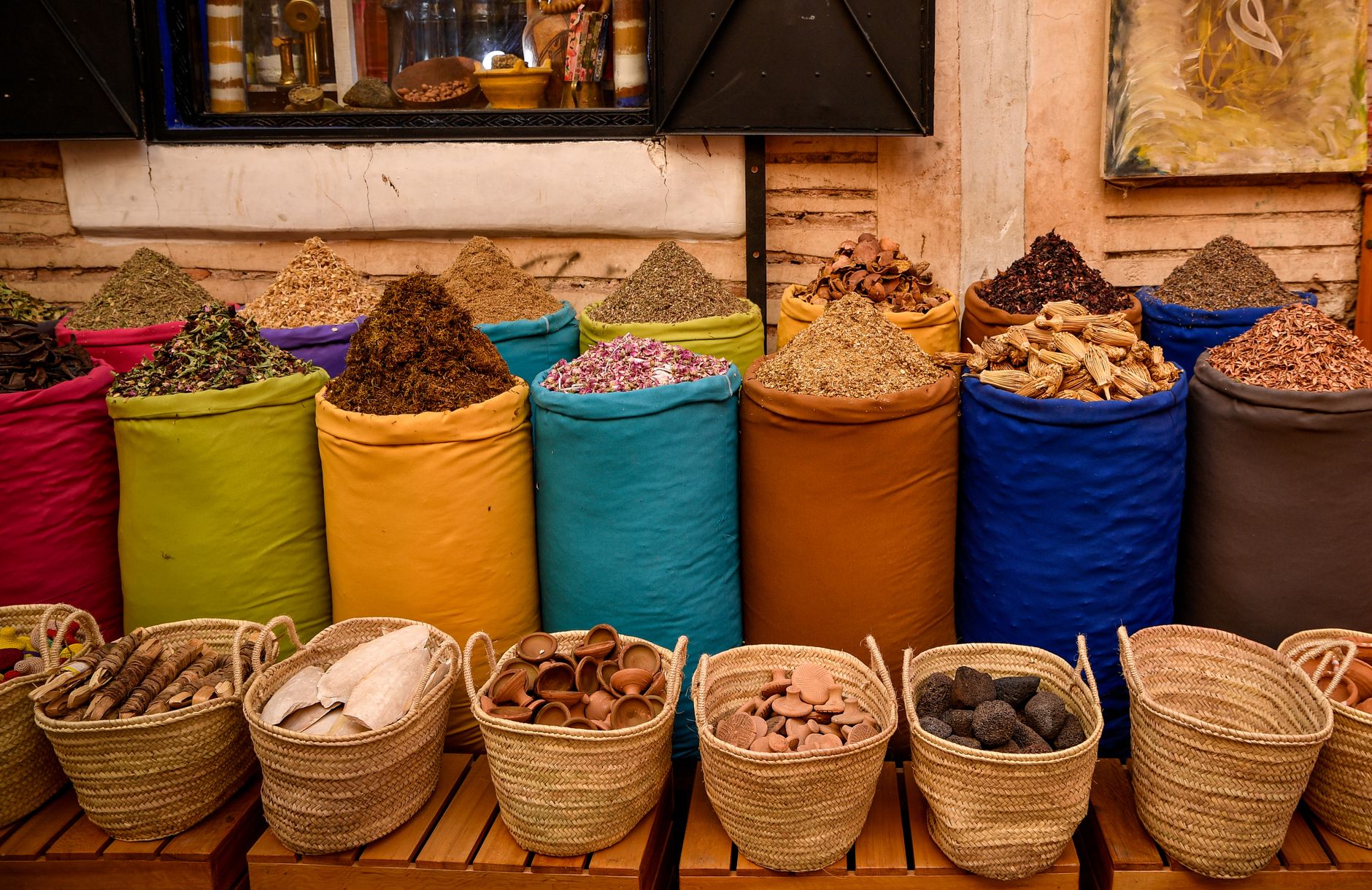
    Stalls and spices in a Moroccan souk
  7. The ten-second checks that save an evening

    Very little goes wrong with money in Morocco, but the handful of annoyances are predictable. In a petit taxi, ask for the meter before you get in — the word is compteur — and if the driver refuses, end the ride politely; agreed fares are normal for airport runs, not for crossing town.

    Check your change: hand over a large note and watch it come back, because no-change stories are the oldest trick at the station. At restaurants, glance at the bill for items you did not order, and remember hotel city tax is settled at checkout, not in the room rate you booked. None of this is paranoia — it is the same five seconds of attention you would pay at home.

How much cash a day actually needs

For a mid-range day — breakfast at the riad, a paid monument, lunch, a taxi, dinner and a mint tea on a roof — 300 to 600 dirhams of cash covers it comfortably, with the hotel and big meals on card. Heavy souk days or multi-driver excursions run higher, and that is what the daily budget in our full cost guide is for.

Do that and money becomes the least interesting part of the trip: a small pile of notes in one pocket, a card for the fixed costs, and every transaction finished with the same three words that work in every souk from Tangier to Marrakech — shukran, and a smile.

  • Draw cash every three or four days, from a bank branch ATM, in dirhams.
  • Keep twenty and fifty dirham notes in a separate pocket for taxis, tips and tea.
  • Let the card pay for hotels, rentals and tours — where the receipt trail is useful.
  • Compare two exchange offices before changing anything by hand.
  • Confirm the taxi meter — compteur — before the wheels move.

Begin your adventure

Your dream Morocco trip starts here

Tell us where you want to go, when, and at what pace — we’ll craft a tailor-made itinerary with private transport, hand-picked riads and local guides.